Most businesses already have a firewall.
The problem is—many don’t know whether it’s actually protecting them properly.
A poorly configured or outdated firewall can expose your network to the internet, slow down systems, and create risks you don’t even realise are there.
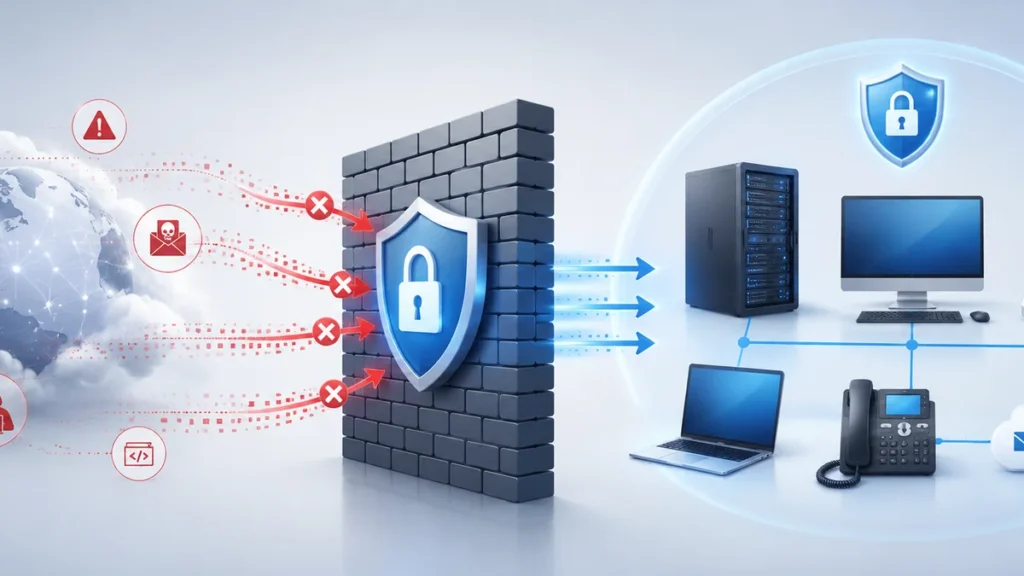
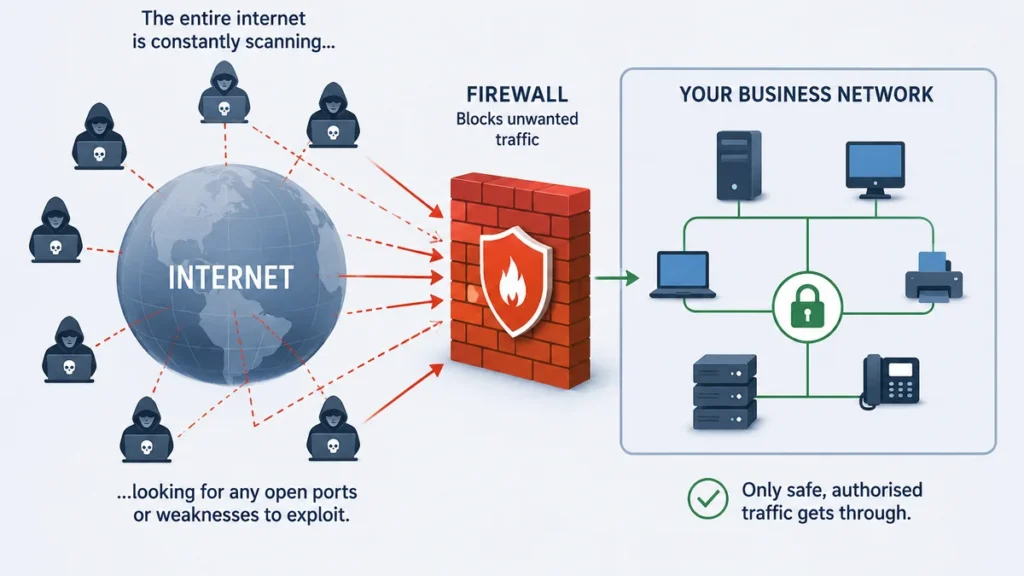
In simple terms, a firewall controls what is allowed in and out of your business network.
But the real question is:
Is your firewall doing that properly?
What Does a Firewall Actually Do?
Think of your firewall as the security guard for your network.
Every time someone:
This usually means:
- Visits a website
- Sends an email
- Uses a cloud system
The firewall checks that traffic before allowing it through.
Most firewalls follow a simple rule:
- Visit BBC → allowed ✅
- External connection attempt → blocked
That’s your first layer of protection.
When the Router Supplied With Your Broadbadnd is No Longer Enough?
A standard broadband router is fine if your business only:
- Browses the internet
- Uses cloud apps
But things change when your setup grows.
For example, if you need to:
- Access CCTV remotely
- Connect to a server from home
- Run VPN access
- Link offices together
- Restrict access to systems
Your firewall becomes far more important.
Firewall Types Compared
| Firewall Type | Best For | Typical Business Size | Main Limitation |
|---|---|---|---|
| ISP Router | Basic internet use | Very small businesses | Limited security & performance |
| Business Firewall | Growing companies | 10–50 users | Requires correct setup |
| Managed Firewall | Critical environments | 25+ users / multi-site | Needs ongoing management |
Your Firewall Is Already Visible Online
Most businesses assume they’re hidden on the internet.
They’re not.
There are internet search engines for connected devices, such as Shodan, which continuously scan networks and catalogue devices.
They can often identify:
- Manufacturer
- Model
- Software version
- Open services
You don’t need to be targeted
You just need to be visible
We regularly see businesses exposing services without realising they’re effectively leaving the front door open.
Why Remote Access Can Be a Risk
Many routers and firewalls allow remote access.
Convenient? ✅
Safe? ❓
Only if configured properly.
If exposed to the internet:
- Password attempts happen constantly
- Vulnerabilities can be exploited
Best practice:
- Disable remote access where possible
- Or secure behind VPN + MFA
Why Firewall Updates Matter
A firewall isn’t just networking hardware.
It’s a computer running software.
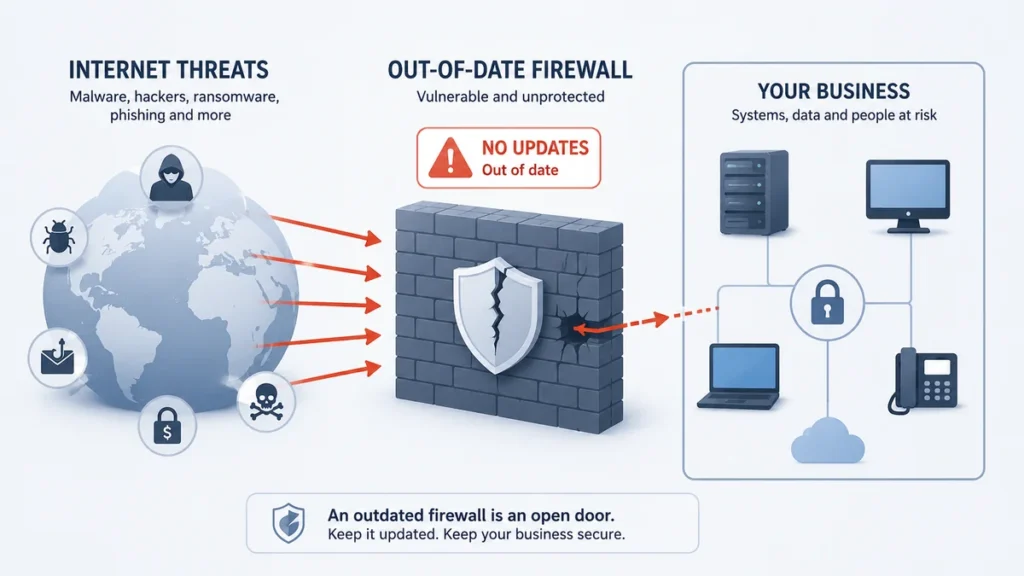
And that software needs updating.
Updates:
- Fix vulnerabilities
- Improve stability
- Improve performance
We often see firewalls that appear “fine” but are years out of date.
That’s where risk builds silently.
In 2019/2020, Travelex was hit by a ransomware attack after criminals got in through an out-of-date remote access system.
The security fix had already been available for months, but it had not been applied.
The result was serious. Travelex had to take systems offline, some staff went back to pen and paper, services used by partner banks were disrupted, and the company later estimated the cyber attack had cost it around £25 million in first-quarter earnings.
That is why keeping firewalls, VPNs and other security systems up to date matters. It is not just an IT housekeeping task — it can be the difference between a normal working day and a major business
When Businesses Replace Firewalls
Firewalls don’t just become insecure.
They become slow.
Example:
- Old firewall → built for 200 Mbps
- New fibre → 1 Gbps
The firewall limits performance
Businesses also outgrow them when they need:
- Security controls
- Remote access
- Site connections
- Reporting
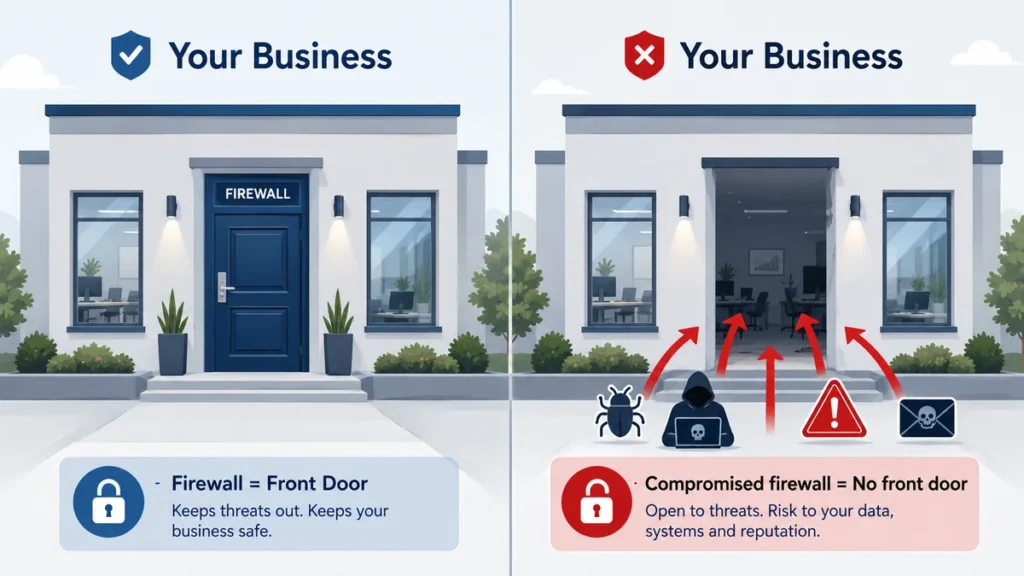
What Happens If a Firewall Is Compromised?
Your firewall sits at the edge of your network.
It’s your front door.
If compromised, an attacker could:
- Monitor traffic
- Identify systems
- Access services
- Disrupt connectivity
Most attacks don’t announce themselves.
They operate quietly in the background.
Modern Firewalls Do Much More
Modern firewalls now include:
- Intrusion prevention
- Malware filtering
- Content filtering
- VPN access
- Application control
👉They control how your network behaves, not just protect it.
Our Approach
At Affirm IT, we take a practical approach.
We ask:
- Is it still supported?
- Is it up to date?
- Is it fast enough?
- Is anything exposed?
- Does it suit your business today?
Sometimes it’s configuration.
Sometimes it’s replacement.
It depends on how you operate.
If you need further advice on your networking equipment or have any other IT-related questions, don’t hesitate to get in touch with us. At Affirm IT, we specialise in providing comprehensive IT support for small businesses in Heanor, Ripley, Ilkeston, and Eastwood
FAQ
Do small businesses need a firewall?
Yes—any business connected to the internet needs some form of firewall protection. The difference is how advanced it needs to be.
Can a firewall stop ransomware?
A firewall can help prevent access and block suspicious activity, but it should be part of a wider security setup including backups and monitoring.
What’s the difference between a router and a firewall?
A router connects you to the internet. A firewall controls what traffic is allowed in and out. Many routers include basic firewall features, but they are limited.
Final Thoughts
A firewall isn’t just another piece of equipment.
It’s the gatekeeper for your entire network.
When it’s configured and maintained properly, it works quietly in the background.
When it isn’t, it can become one of the biggest risks in your business—without you even realising it.
Need Help?
If you’re unsure whether your firewall is still fit for purpose, or what’s exposed to the internet, we can review it and explain everything clearly.
https://affirmit.co.uk/contact