For manufacturing businesses, IT is no longer simply about fixing computers when something goes wrong.
Technology now underpins almost every part of the operation, from ERP systems and production equipment to inventory management, communications, cybersecurity, and business continuity. In fact, according to IT Pro, 78% of UK manufacturers experienced a cybersecurity incident in the last 12 months, with 53% reporting revenue loss as a result. As a result, when it comes to IT for manufacturing, the manufacturers may find themselves asking an important question:
Should industrial IT services be outsourced, managed internally, or a combination of both?
For manufacturers with around 25 to 50 employees, the answer is often not as straightforward as choosing one option over the other. In many cases, when it comes to manufacturing IT support, the most effective solution is a hybrid approach that combines the business knowledge of an internal IT manager with the expertise and resilience of an external IT provider.
The real question is not outsourced versus in-house IT. It’s whether your current setup provides enough expertise, resilience, and capacity to support future growth.
The Three Main IT Support Models for Manufacturers
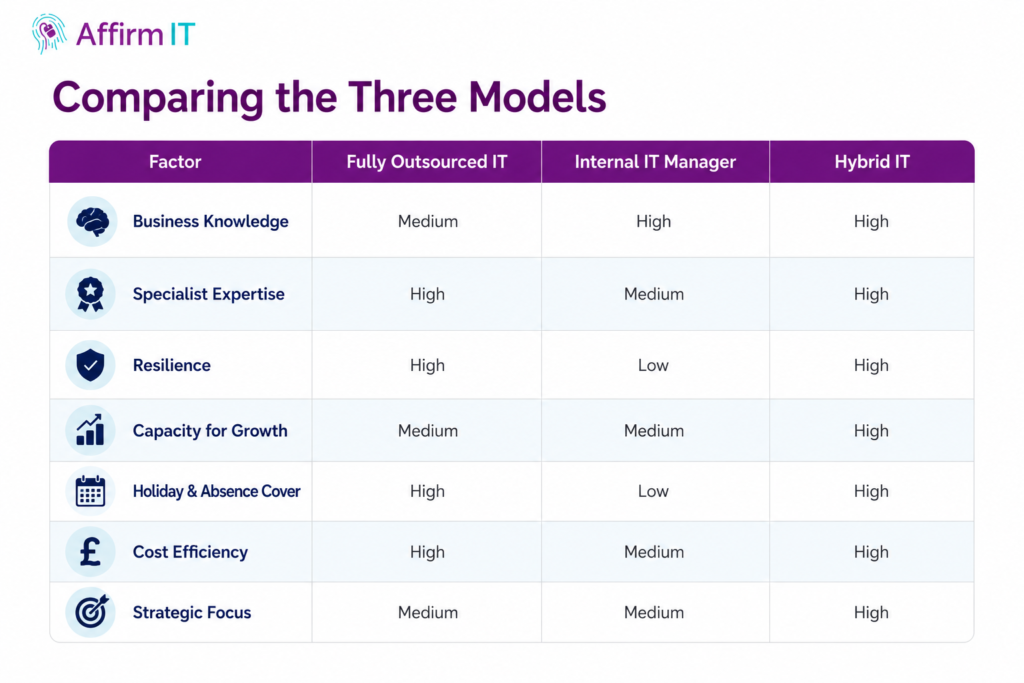
Most manufacturing businesses operate using one of three IT support structures, which are fully outsourced IT, an internal IT manager, and hybrid IT support, each with its own risks and advantages.
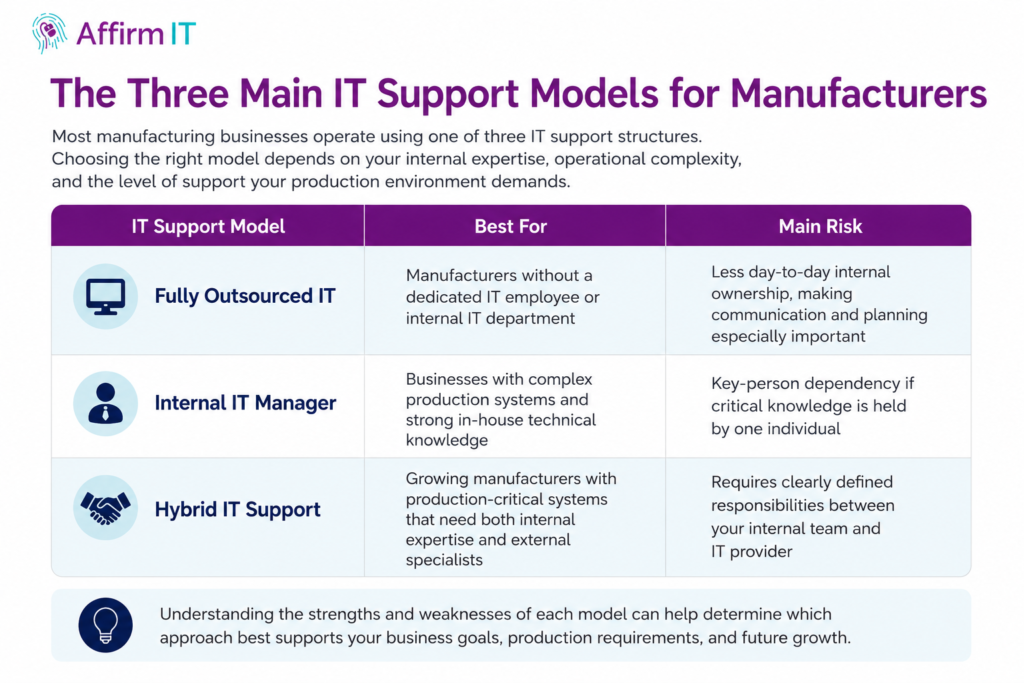
Understanding the strengths and weaknesses of each model can help determine which approach best supports your business goals.
Why Manufacturers Are Reassessing Their IT Structure
As manufacturing operations become increasingly reliant on technology, the demands placed on IT solutions for manufacturing continue to grow.
Modern IT teams are expected to manage:
- User support and troubleshooting
- Manufacturing cybersecurity and compliance
- Network infrastructure
- Cloud platforms and Microsoft 365
- Backup and disaster recovery
- ERP and production systems
- Software updates and maintenance
- Business continuity planning
For many businesses, these responsibilities are handled by a single individual or a small team. As the organisation grows, this can create capacity challenges, increase operational risk, and limit opportunities for strategic improvement.
Model 1: Fully Outsourced IT Support
For many manufacturers, a fully outsourced IT model works extremely well.
Under this arrangement, all IT services are managed by an external provider. This typically includes:
- Helpdesk support
- Monitoring and maintenance
- Cybersecurity management
- Software updates
- Backup management
- Infrastructure support
One common misconception is that outsourced managed IT services for manufacturing should feel busy. In reality, the opposite is true.
When managed properly, outsourced IT should feel quiet.
Behind the scenes, systems are continuously monitored, maintained, and improved. Potential problems are often identified and resolved before they have an opportunity to disrupt users or impact production.
As cyber threats evolve and become much more sophisticated, the importance of preventing the problem grows. According to Sophos, the average cost of recovering from a ransomware attack for manufacturing companies is around £989,000. This just reinforces the importance of proactive monitoring and maintenance.
Benefits of Fully Outsourced IT
- Access to a broad range of technical expertise
- Predictable monthly costs
- Reduced management burden
- Improved resilience and coverage
- Access to specialist cybersecurity knowledge
Potential Drawbacks
- Less day-to-day internal ownership
- Reduced familiarity with internal processes
- Some businesses may prefer a dedicated on-site presence
For manufacturers without a dedicated IT employee, fully outsourced support can provide a cost-effective way to access enterprise-level expertise without the overhead of building an internal team.
Model 2: Internal IT Manager
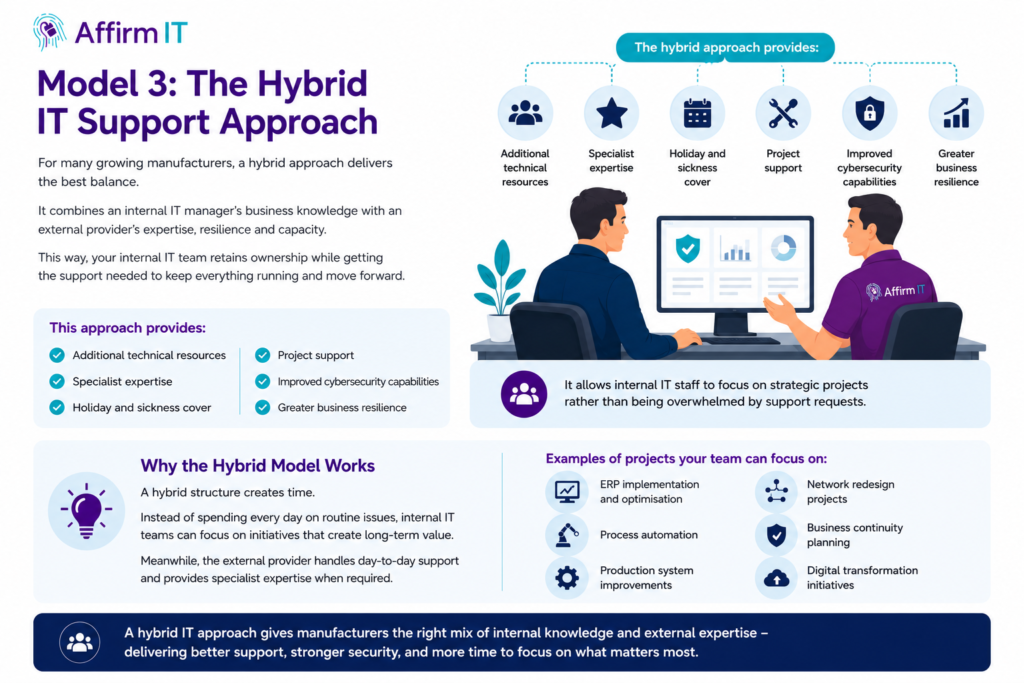
Many manufacturers have an internal IT manager who has played a significant role in the growth of the business.
They understand the organisation’s systems, processes, people, and challenges better than anyone else.
This knowledge is incredibly valuable.
An experienced internal IT manager often understands:
- Production processes
- ERP systems
- Business workflows
- Historical infrastructure decisions
- Department-specific requirements
However, problems can arise when one person becomes responsible for everything.
They may be expected to manage:
- Printer issues and user support
- Windows updates
- Cybersecurity
- Backups
- Network infrastructure
- Production systems
- Strategic IT projects
As a result, much of their time is spent dealing with day-to-day operational tasks rather than focusing on improvements that move the business forward.
Benefits of an Internal IT Manager
- Deep understanding of the business
- Strong relationships with users and departments
- Fast decision-making
- Direct ownership of systems and processes
Potential Drawbacks
- Limited capacity
- Specialist knowledge gaps
- Lack of holiday or sickness cover
- Increased reliance on one individual
The Key-Person Risk Many Manufacturers Overlook
One of the biggest challenges with a single internal IT manager is dependency.
The issue is rarely a lack of technical capability.
The problem is that too much knowledge sits with one person.
If that individual leaves unexpectedly, the business can quickly find itself exposed.
We’ve seen situations where businesses discovered:
- Nobody knew the firewall credentials
- Backup configurations weren’t properly documented
- Software licences couldn’t be accessed
- Critical systems lacked clear ownership
- Nobody knew who controlled the Microsoft 365 tenant
These issues often remain hidden until a problem occurs.
Unfortunately, by that stage, recovery is usually happening under pressure.
Why One Person Can’t Know Everything
Even highly capable IT professionals face one unavoidable limitation.
They only see one environment.
An internal IT manager may know your systems inside out, but they may not have exposure to:
- How other manufacturers solved similar challenges
- Best practices from multiple industries
- Advanced cybersecurity incidents
- Large-scale cloud migrations
- Multi-site infrastructure projects
External IT providers work across numerous environments and gain experience from a wide variety of situations.
That wider perspective often becomes incredibly valuable when businesses encounter new challenges or enter periods of growth.
Model 3: The Hybrid IT Support Approach
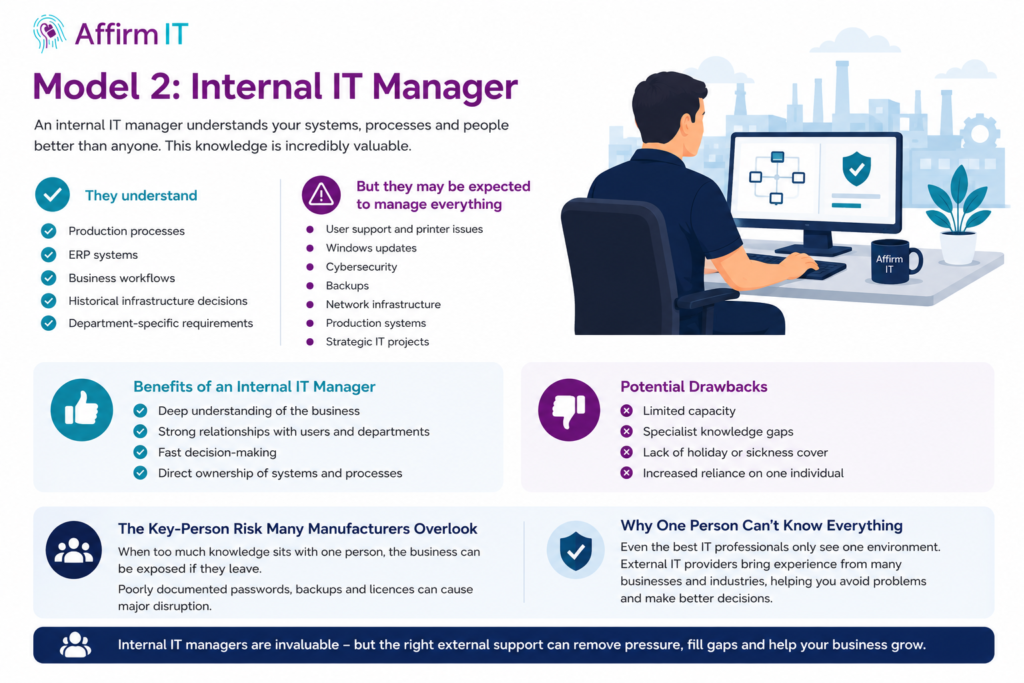
For many growing manufacturers, a hybrid approach delivers the best balance.
Instead of choosing between an internal IT manager and an outsourced provider, businesses combine both.
The internal IT manager retains ownership of the environment and contributes valuable business knowledge, while the external provider delivers additional expertise, resilience, and capacity.
This approach provides:
- Additional technical resources
- Specialist expertise
- Holiday and sickness cover
- Project support
- Improved cybersecurity capabilities
- Greater business resilience
Perhaps most importantly, it allows internal IT staff to focus on strategic projects rather than being overwhelmed by support requests.
Why the Hybrid Model Works
One of the biggest advantages of a hybrid structure is that it creates time.
Instead of spending every day resolving routine issues, internal IT teams can focus on initiatives that create long-term value.
These might include:
- ERP implementation and optimisation
- Process automation
- Production system improvements
- Network redesign projects
- Business continuity planning
- Digital transformation initiatives
Meanwhile, the external provider handles day-to-day support and provides specialist expertise when required.
A Real Manufacturing Example
We supported a manufacturer with a single production facility that employed one internal IT manager.
The IT manager had extensive knowledge of the business but was overwhelmed by support requests that demanded immediate attention without necessarily delivering strategic value.
By taking responsibility for first-line and second-line support, we helped reduce the volume of day-to-day issues landing on their desk.
This allowed them to focus on more valuable projects, including:
- Improving line-of-business applications
- Introducing automation and systemisation
- Project-managing an ERP implementation
- Enhancing network infrastructure
Together, we also strengthened the organisation’s resilience by:
- Implementing practical, testable backups that were checked daily
- Segmenting the network using VLANs
- Reviewing cloud and on-premise infrastructure requirements
- Improving disaster recovery capabilities
Having reliable backups is one of the most effective ways to recover from a cyberattack. In fact, Sophos found that over half (58%) of manufacturers used backups to restore their data after a ransomware attack. This highlights the importance of regularly testing backup and disaster recovery plans.
At one point, the business experienced an internet outage. However, because critical manufacturing systems had been designed to operate locally and were properly protected, production continued uninterrupted.
Over time, the organisation expanded from a single site to multiple factories across Britain and Europe.
Its internal IT capability grew as well, but the external support remained in place, providing an ongoing layer of resilience, project support, and specialist expertise.
These improvements reflected recognised cybersecurity best practice, reducing the likelihood that a single incident could affect both office systems and manufacturing operations.
Comparing the Three Models
Which IT Model Is Right for Your Manufacturing Business?
Every manufacturer is different, but asking three simple questions can help guide the decision.
- Do You Have Enough Expertise?
Can your current team effectively manage cybersecurity, infrastructure, cloud services, production systems, and compliance requirements?
- Do You Have Enough Resilience?
Would your business continue to operate effectively if a key member of the IT team were unavailable tomorrow?
- Do You Have Enough Capacity?
Does your IT function have the time and resources to focus on strategic improvements, or is it constantly reacting to day-to-day issues?
The answers often reveal whether your current structure is supporting growth or holding it back.
Outsourcing vs In-House IT for Manufacturers: Frequently Asked Questions
- What is the difference between outsourced and in-house IT support?
The difference between the two is that outsourced IT support is delivered by an external provider that manages your cybersecurity, technology, and general day-to-day IT operations. Whereas in-house IT support is managed by employees of your organisation who have direct knowledge of your business processes and systems. Many manufacturing companies choose an approach that is hybrid, meaning it combines both models to benefit from internal knowledge as well as external expertise.
- Is outsourced IT support suitable for manufacturing businesses?
Outsourced IT support for manufacturers is perfectly suitable, as many manufacturing businesses use outsourced IT support to gain access to specialist expertise in various areas, such as cloud services, network management, cybersecurity and disaster recovery.
- What is hybrid IT support?
Hybrid IT support combines an IT manager or internal IT team with an external managed service provider (MSP). The external provider delivers additional technical expertise, day-to-day support and resilience, whilst your internal team retains ownership of business systems and strategic projects.
- When should a manufacturer consider moving to a hybrid IT model?
A hybrid model may be worth considering if your internal IT team is struggling with workload, lacks specialist expertise or relies heavily on one individual. It can provide additional capacity while allowing internal staff to focus on strategic projects rather than routine support requests.
- How do I know which IT support model is right for my business?
This completely depends on the size of the company, resources and overall goals. You should consider whether your current IT function has the resilience, expertise and capacity to support your business at to expands and grows. Reviewing these areas can help determine whether an in-house, outsourced, or hybrid IT solution is the best fit.
Final Thoughts
The decision isn’t simply whether IT should be outsourced or managed internally when it comes to IT support for manufacturers.
The more important question is whether your current setup provides the expertise, resilience, and capacity your business needs to grow with a manufacturing technology strategy.
For many manufacturers, the strongest approach is not to choose one option over another.
It’s combining the strengths of both.
A well-structured hybrid IT model can reduce risk, improve operational resilience, support strategic growth, and ensure technology remains an enabler rather than a constraint.
Need Help Reviewing Your IT Structure?
At Affirm IT, we support manufacturers through both fully outsourced and hybrid IT models.
Whether you’re looking to strengthen resilience, improve operational efficiency, or free up your internal team to focus on strategic projects, we can help you assess your current environment and identify the most effective way forward.
Get in touch to discuss your current IT setup and explore the options available to your business with an IT partner for manufacturers.